
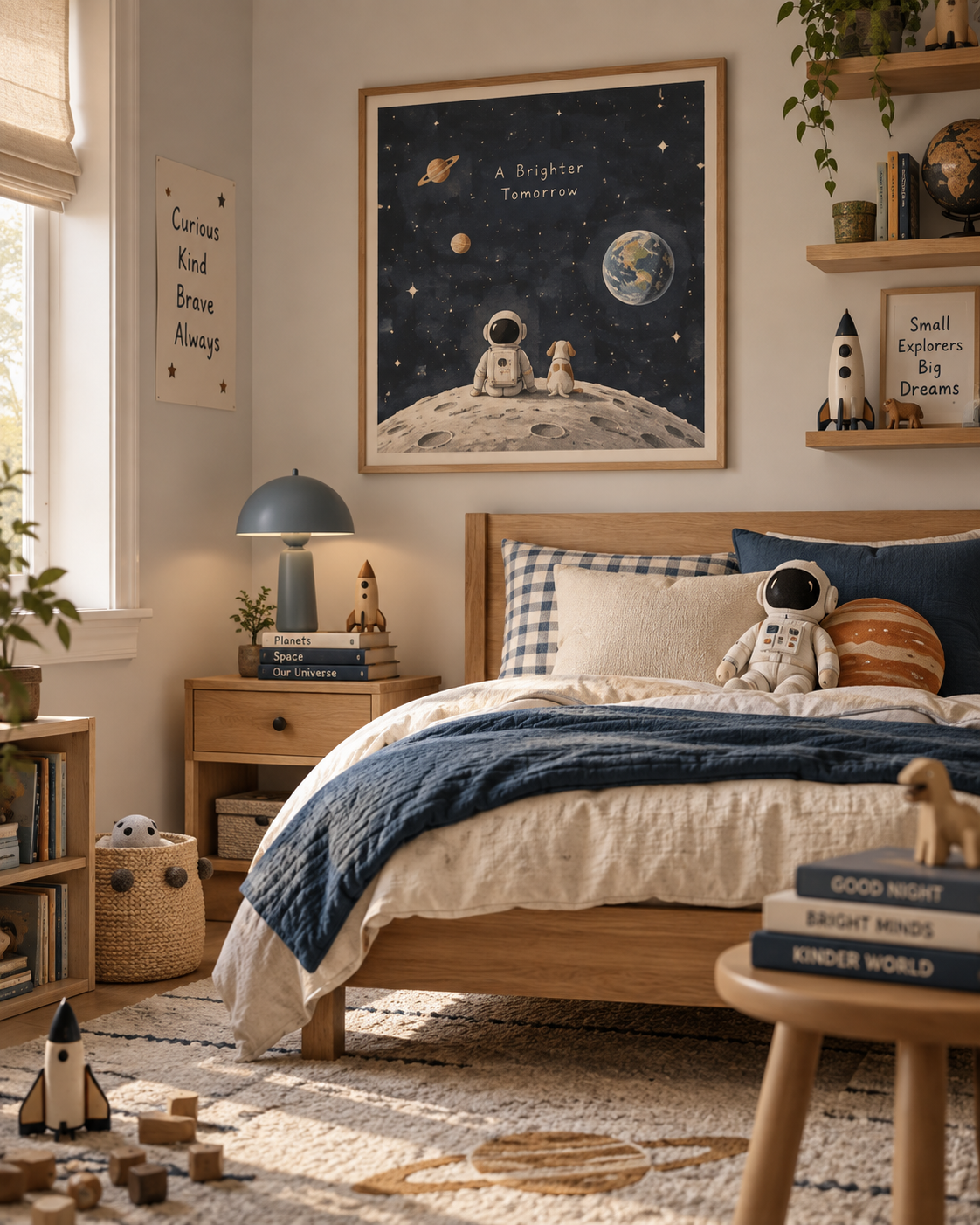
When people choose wall art, it is easy to focus only on the image itself. Does the color look right? Is the subject interesting? Will it fit the theme of the room? Those questions matter, but for us at North & Nook, they are only the beginning.
A piece of wall art never exists by itself for very long. Once it enters a child’s room, it becomes part of a larger picture.
There is the bed beneath it, the lamp beside it, the books on the shelf, the toys on the floor, the color of the walls, the texture of the bedding, and all the small objects that belong to the child who lives there. Even the amount of empty space around the artwork changes how it feels.
That is why we rarely think about the wall in isolation.
We think about the room.
A design can look beautiful on a screen and still feel wrong once it is placed above a real bed. Sometimes the colors are too strong compared with the rest of the space. Sometimes the artwork is too detailed for a room that already has patterned bedding, shelves, toys, and other decoration. Sometimes the size is wrong, and the piece either disappears on the wall or overwhelms everything around it.
The artwork itself may not be the problem. The relationship between the artwork and the room may be.
That relationship is what interests us.
When we work on a design, we try to imagine the space where it might eventually live. If the artwork contains deep navy, warm ochre, or muted green, we think about how those colors might sit beside light wood, cream bedding, or a soft gray wall. If the composition is already visually busy, we think about whether the room will still have enough breathing space once the piece is hung.
This does not mean every room needs to be perfectly coordinated.
In fact, we prefer the opposite.
Children’s rooms are more interesting when they feel collected over time. A favorite stuffed animal may not match the color palette. Books may introduce colors that were never part of the original plan. A blanket may come from a grandparent. A toy may become so important that it ends up sitting on the bed every day.
Those things give a room personality.
The artwork should be able to live alongside them.
That is one reason we are careful not to make every North & Nook design too demanding. If the artwork already insists on being the loudest thing in the room, everything else has to work around it. We would rather create pieces that can hold attention without taking over.
Scale plays a large part in this.
A piece above a twin bed should feel different from one above a small reading nook or dresser. The width of the furniture, the height of the headboard, and the amount of wall surrounding the artwork all affect how balanced the arrangement feels.
We do not think the goal is to make a piece look as large as possible.
The goal is to make it feel believable in the space.
When the scale is right, the artwork begins to feel connected to the furniture instead of simply floating on the wall. The room feels more settled, even if the arrangement is simple.
The same is true for placement.
Art hung too high can feel disconnected from the rest of the room. Too low, and it may compete with the headboard or furniture below it. A cluster of several pieces can work beautifully in some spaces, while in others a single larger piece creates a much calmer result.
There is no single rule that works for every room.
That is exactly why the whole room matters.
We also think about how a space changes throughout the day.
Natural light can make colors appear softer in the morning and deeper in the evening. A lamp beside the bed changes the mood again at night. Textures become more noticeable when the room is quieter. A piece of artwork that looks bold in bright daylight may feel much calmer under warm evening light.
These small changes are part of how the room is actually experienced.
A children’s bedroom is not a static picture.
It is a place for sleeping, reading, playing, getting dressed, talking, imagining, and growing. The room has to work for all of those moments, not just look good in one photograph.
That is why we try to leave flexibility in the way we design.
A room should be able to change without needing to be completely redesigned every time a child grows into a new interest. Wall art can help give the room direction, but it should not lock the whole space into one narrow idea.
A space-themed artwork does not require space-themed bedding, rocket-shaped lamps, star curtains, and planets on every surface. Sometimes one piece is enough to introduce the story.
The rest of the room can stay open.
That openness makes it easier for the child’s own personality to become part of the design.
For us, that is more important than creating a room that looks perfectly styled.
We want the artwork to feel as though it belongs there, but we also want the room to keep belonging to the child.
That balance is why we think beyond the wall.
The wall is only one part of the story.
The room is where the story actually lives.