
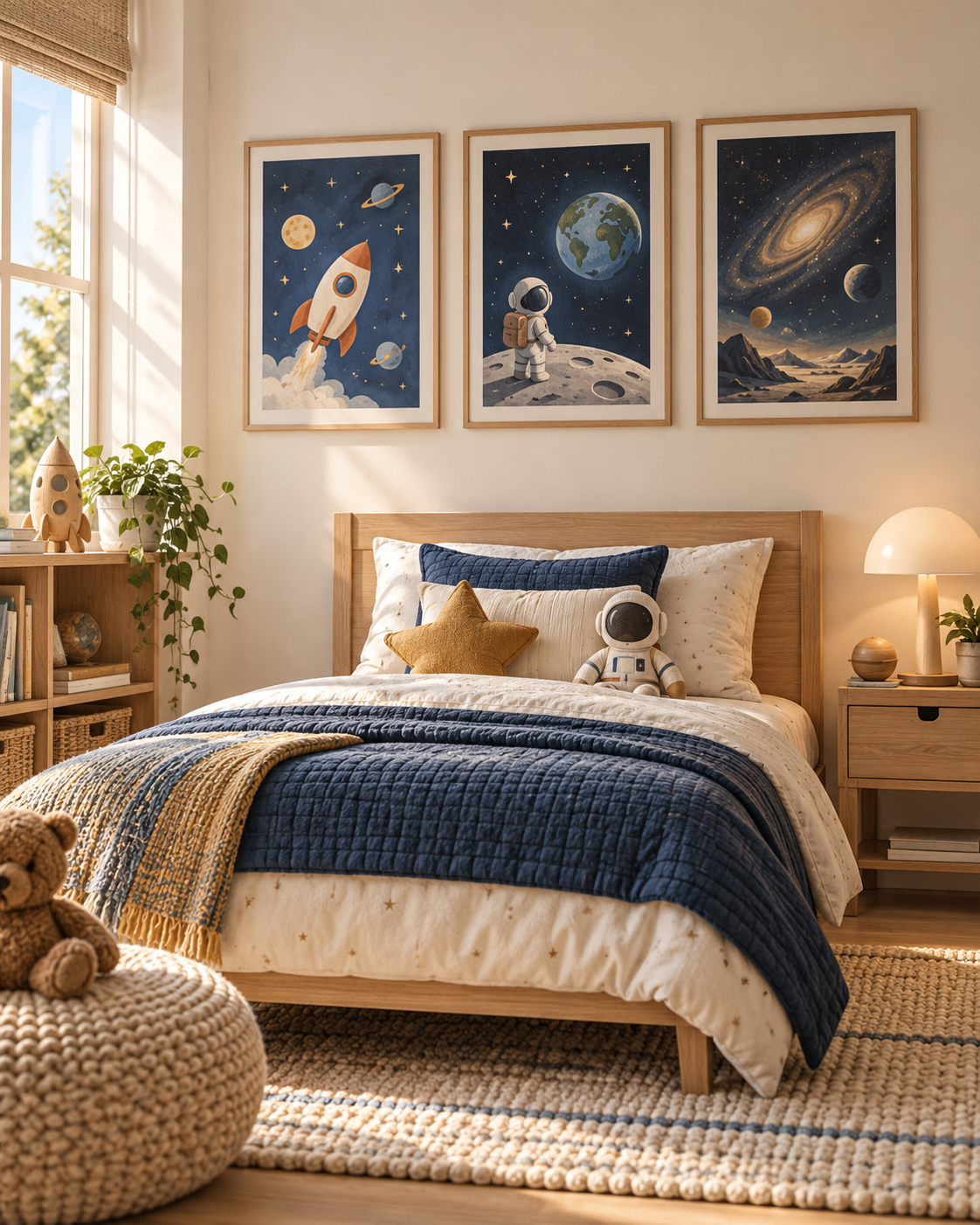
Space has always had a special place in children’s imagination. It is distant enough to feel mysterious, but familiar enough to feel inviting. Children see the moon from their bedroom windows, recognize planets from books and school, and quickly turn rockets, astronauts and stars into stories of their own.
That sense of wonder is what drew us to create the North & Nook Space Collection.
We did not want to treat space as a single visual theme that could simply be repeated in different colors. A room for a four-year-old who loves rockets should not necessarily feel the same as a room for a ten-year-old who has started asking questions about planets, exploration and the universe. The subject may be the same, but the way a child experiences it changes as they grow.
So instead of beginning with the question, “What should a space picture look like?” we began with a different one: What kind of space story belongs in this child’s room?
That question eventually shaped the collection into three different directions.
For younger children, we wanted space to feel playful and welcoming. Rockets, friendly astronauts and simple planets create a world that feels easy to enter. There is movement and imagination, but not so much detail that the artwork becomes overwhelming. These designs are less about explaining the universe and more about giving a child a place to begin imagining it.
As children grow, adventure becomes more important. Space is no longer simply something floating in the sky. It becomes somewhere to go. An astronaut standing on the moon, Earth appearing in the distance, or a spacecraft moving through an open landscape introduces the feeling of exploration. The compositions can become a little more dramatic and the storytelling a little deeper, while still remaining comfortable in a child’s bedroom.
For older children, we wanted the collection to move further toward discovery. Galaxies, planetary landscapes and more atmospheric scenes allow the artwork to feel less like nursery decoration and more like something that can remain interesting as the child gets older. The sense of wonder is still there, but it becomes quieter and more expansive.
This progression became an important part of how we think about the collection: Playful Space, Adventure Space and Discovery Space are not simply different styles. They represent different ways children might connect with the same subject at different stages.
That also influenced the way we use color.
Space artwork can easily become very dark. Deep navy backgrounds, bright stars, intense purples and glowing planets can create a dramatic image, but placed inside a bedroom, too much contrast can make the wall feel heavier than we want.
We try to find a balance between the atmosphere of space and the feeling of the room around it. Darker blues may be softened by warmer neutrals. Bright details are used selectively rather than everywhere. A planet, rocket or moon can become the focal point without needing every part of the artwork to compete for attention.
The goal is not to remove excitement from space. It is to make that excitement comfortable enough to live with every day.
The same principle affects composition. Space offers almost endless possibilities: planets, stars, moons, astronauts, rockets, satellites and constellations can all belong in the same scene. But putting everything into one picture rarely creates the strongest result.
We usually begin by deciding what the story of the piece is actually about.
If the story is a rocket beginning an adventure, the rocket should have room to move. If it is an astronaut exploring the moon, the landscape and the distance around the figure help create the feeling of exploration. If it is about looking into a galaxy, the open space itself becomes part of the design.
Leaving something out can be just as important as adding something in.
This becomes especially clear when we imagine the artwork inside a real bedroom. The picture may eventually sit above a bed surrounded by pillows, blankets, books, toys and furniture. A design that already feels completely full on its own can make the whole wall feel crowded once everything else is added.
We would rather the artwork become part of the room than take control of it.
That is why the Space Collection is designed around more than the artwork itself. We think about where the piece might hang, how large it might appear above furniture, how its colors could work with bedding and wood tones, and whether it still leaves enough visual space for the child’s own belongings.
The room does not have to become a complete “space room” just because there is space art on the wall.
Sometimes one carefully chosen piece is enough to introduce the story.
A rocket above the bed might become something a child notices before falling asleep. An astronaut on the moon might begin a conversation about where people have travelled. A view of distant planets might simply make someone wonder what could be out there.
Those small moments are more interesting to us than creating a room in which every object repeats the same theme.
There is another reason we wanted the Space Collection to have different levels of maturity. Children change quickly, and decorating a room around a very specific age can make the space feel outdated almost as quickly.
We cannot design something that every child will love forever, nor do we think that should be the goal. But we can try to create artwork that does not underestimate them.
A younger child may love the rocket first because it looks exciting. Later, the same interest might lead to questions about the moon, planets or how astronauts live in space. The subject has room to grow with them.
That idea of growth is something we want to carry through North & Nook as a whole.
We are not trying to create children’s rooms that look perfectly finished and then remain unchanged. Childhood does not work that way. Interests develop, furniture moves, favorite objects change and new stories take the place of old ones.
Our Space Collection is meant to live comfortably within that process.
It begins with something simple: the feeling of looking up and wondering what is beyond what we can see.
For one child, that may mean a friendly rocket and a sky full of stars. For another, it may be an astronaut taking the first step onto an unfamiliar world. For someone a little older, it may simply be the quiet scale of a galaxy stretching far beyond the page.
The images may change, but the feeling behind them is the same.
A little curiosity.
A little imagination.
And enough open space for a child to decide where the story goes next.