
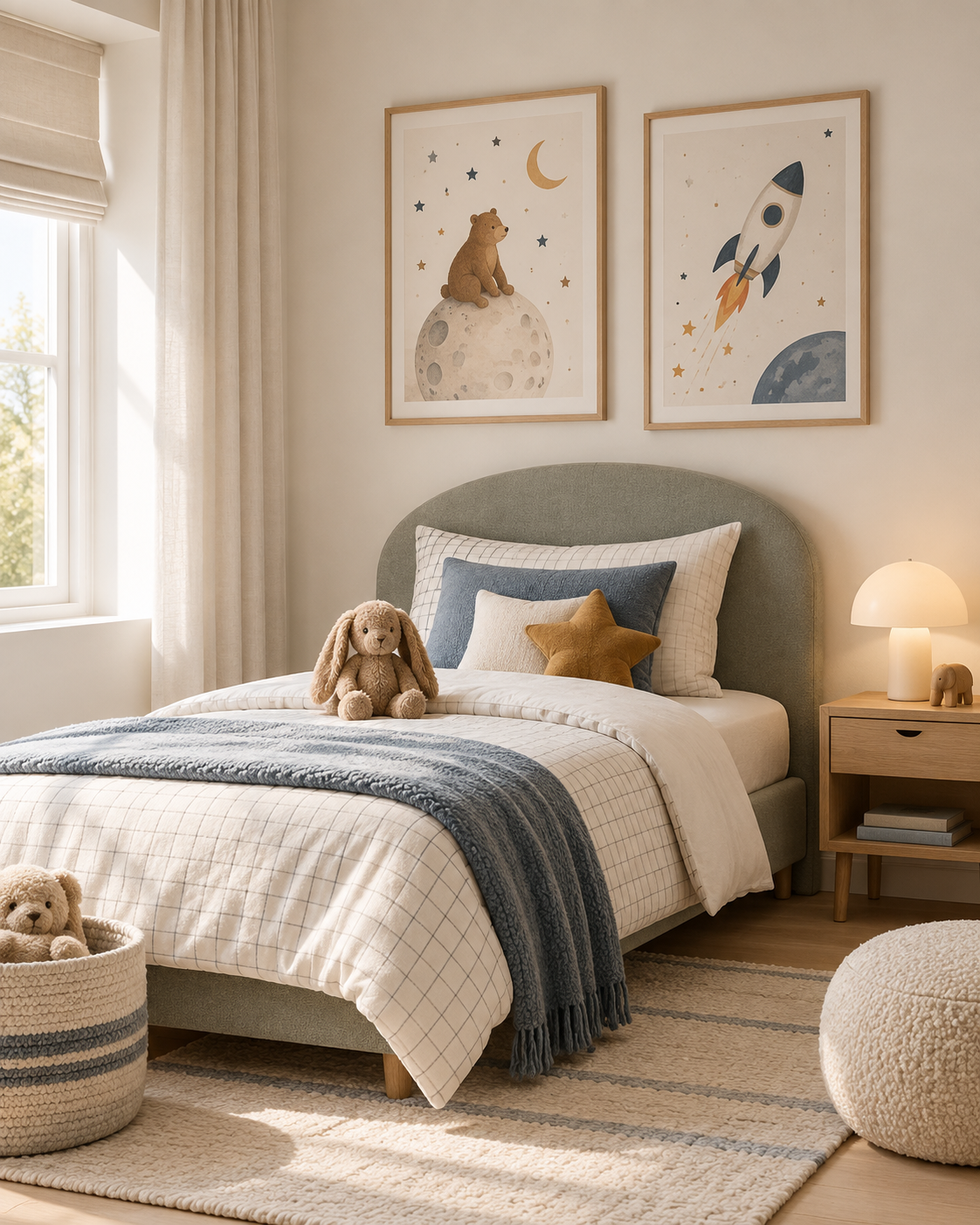
Children’s rooms are rarely empty spaces waiting to be decorated. Even a simple bedroom quickly fills with the things that belong to everyday childhood: books beside the bed, favorite toys, blankets, storage baskets, school projects, and objects that seem to appear almost overnight. A room can change surprisingly quickly as a child develops new interests, discovers new favorite colors, or moves from one stage of childhood to another.
That is why, when we design wall art at North & Nook, we are not only thinking about what looks good inside the frame. We are thinking about everything that will eventually surround it.
It can be tempting to treat an empty wall as a place that needs filling. Add another picture, another shelf, another decorative object, and then another. But a child’s bedroom already contains plenty of visual information. The challenge is often not finding something else to add. It is knowing how much the room actually needs.
For us, good wall art should bring something to a space without asking the rest of the room to compete with it.
That begins with the composition of the artwork itself. Children’s designs naturally invite playful details. A space scene could contain rockets, planets, astronauts, stars, moons, satellites, constellations and dozens of small objects floating through the background. A dinosaur scene offers just as many possibilities. It is easy to keep adding because every new element seems charming on its own.
But more does not automatically make an illustration more imaginative.
We usually prefer to give a design one clear idea and enough room around that idea for it to be noticed. A rocket might become the focus of a space illustration while a few planets and stars quietly establish the world around it. A dinosaur does not need to be surrounded by every prehistoric creature we can fit onto the canvas. Sometimes a single character, a simple landscape and a handful of carefully chosen details tell a stronger story.
The quieter areas matter just as much as the illustrated ones. They give the eye somewhere to rest and prevent the artwork from feeling crowded once it is placed in a real bedroom.
This becomes even more important because wall art is never viewed in isolation. Above a child’s bed there may already be patterned bedding, a favorite stuffed animal and a bedside lamp. Across the room there may be books, toys and storage. The child brings their own personality into the space long before an artwork arrives.
We therefore try to imagine the finished room while we are still working on the design.
Would the piece remain comfortable to look at above patterned bedding? Would its colors work alongside natural wood furniture? Would it still feel balanced if the room contained toys that did not perfectly match the decorating scheme?
Those questions are more useful to us than asking whether an illustration looks impressive by itself.
Color plays a large part in that balance. Children’s rooms are often associated with bright, saturated colors, but playful does not have to mean loud. A strong blue, warm ochre or deep green can give a design plenty of character when it is surrounded by softer tones. The quieter colors give the stronger ones a chance to work.
This is particularly important in bedrooms. A child’s bedroom may be a place for imagination during the day, but it is also somewhere to wind down in the evening. We like the idea that both things can exist in the same room. A space-themed bedroom can still feel restful. A dinosaur room can feel adventurous without looking chaotic. An ocean theme can feel full of discovery without covering every surface with decoration.
The balance also depends on scale. Wall art that looks convincing in an isolated product image may feel completely different once it is placed above a real bed. If it is too small, it can look lost on the wall. If it is too large, it can dominate everything around it.
We prefer to think about artwork in relation to the furniture and open space nearby. The width of a bed, the height of a headboard and the amount of empty wall around the piece all influence how comfortable the finished arrangement feels. The aim is not to make the artwork look as large or dramatic as possible. It is to make it look as though it naturally belongs in that room.
This way of thinking also means accepting that children’s rooms will never remain perfectly styled.
A child may suddenly become obsessed with dinosaurs. A pile of books may stay next to the bed because those are the ones being read every night. A stuffed animal that matches absolutely nothing may become the most important object in the room.
That is part of what makes the space theirs.
We do not want North & Nook artwork to require a perfectly coordinated room around it. We would rather create pieces that leave enough visual room for the child’s own things to exist alongside them.
That is also why we are careful about the idea of a “calm” children’s room. Calm does not mean removing all personality. It does not mean making every room beige, minimal or overly grown-up. Children’s spaces should still contain curiosity, humor, color and imagination.
The difference is that those elements do not all have to compete for attention at the same time.
A room can contain a rocket heading toward the moon, a shelf of colorful books and a much-loved stuffed rabbit without feeling overwhelming. When each part has enough space around it, the room begins to feel collected rather than crowded.
This is the balance we look for when we design.
We want the artwork to give a child something to notice and imagine, but we also want it to live comfortably with everything else that makes the room personal. Sometimes that means adding a small detail. Just as often, it means taking one away.
Because a children’s room does not need to be filled to feel special.
Sometimes leaving a little space is what allows the story of the room—and the child living in it—to come through.