
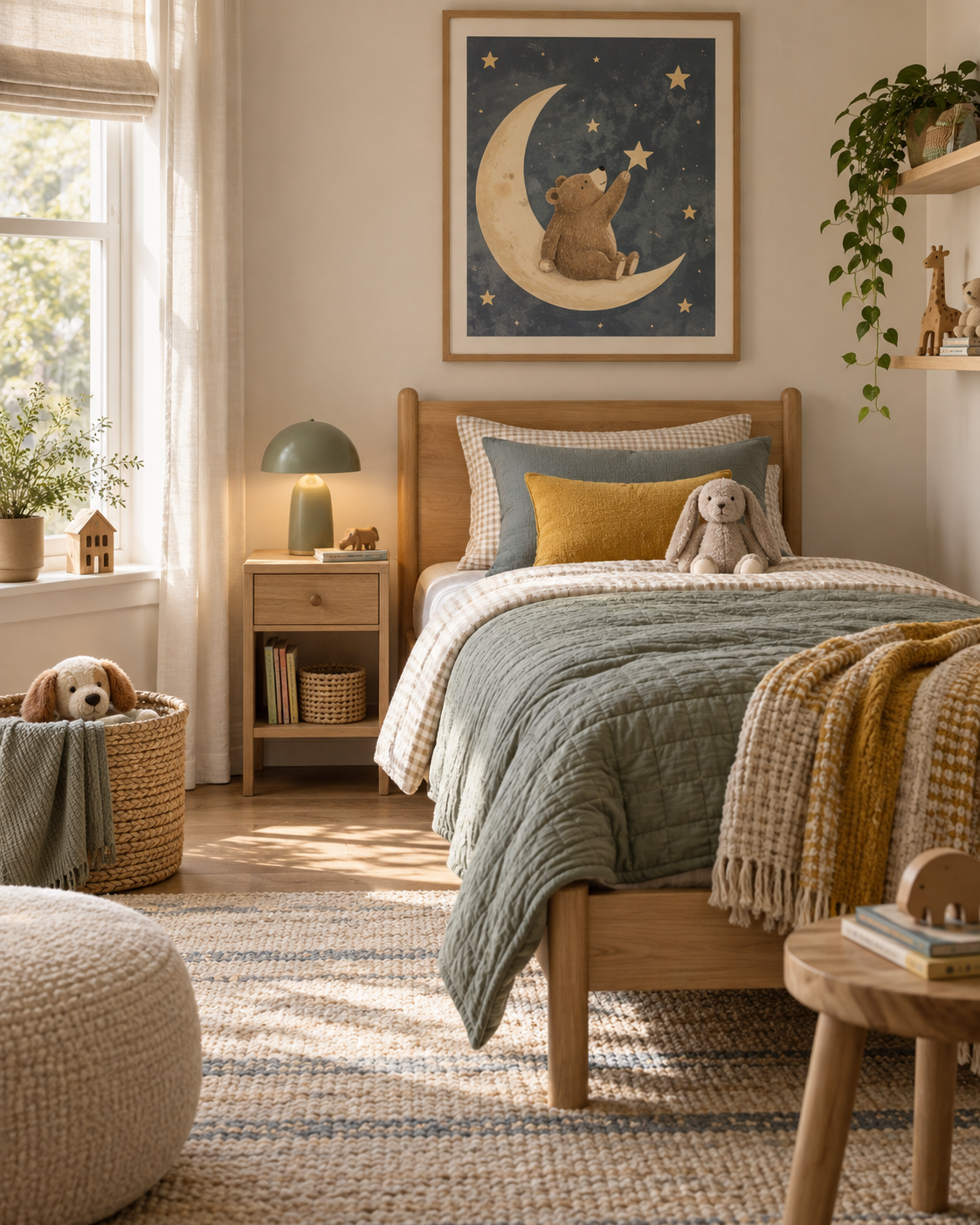
There is a common misunderstanding around calm children’s rooms. The word “calm” often brings to mind spaces that are pale, minimal, carefully controlled, and almost too quiet to feel like they belong to a child. But that is not what calm means to us at North & Nook.
A child’s room can be full of personality and still feel peaceful. It can include color, favorite characters, stories, playful artwork, books, toys, and all the small things that make the space feel lived in. Calm is not the absence of those things. It is the way they are allowed to exist together without competing for attention.
That distinction matters, because children do not need rooms that look like they were designed for adults. They need spaces that feel like their own.
When we think about calm design, we are thinking about balance. A room might have a deep blue wall, a bright piece of wall art, or a playful dinosaur illustration, but those stronger elements can be balanced by quieter bedding, natural wood, open wall space, or a simpler arrangement around them. The room still has character, but it does not feel visually crowded.
This is often where color gets misunderstood.
Calm does not mean removing color. In fact, color can be one of the most expressive parts of a child’s room. The key is how it is used. A muted blue can create depth without feeling heavy. A warm ochre can add energy without taking over the room. Soft green, terracotta, navy, cream, and warm wood tones can all work together in a way that feels playful and grounded at the same time.
We often prefer to let one or two colors do the work rather than asking every object in the room to become a statement.
The same idea applies to wall art. A strong piece of art does not need a dozen supporting decorations around it. Sometimes one large image above a bed creates more impact than a wall filled with smaller pieces. Sometimes a simple composition with one clear subject feels more imaginative than an illustration packed with detail.
That may sound contradictory, but imagination does not depend on quantity.
A rocket crossing an open night sky can suggest an entire adventure. A single dinosaur in a wide landscape can feel more mysterious than a scene filled with ten different creatures. An astronaut standing on the moon can create more curiosity when there is space around the figure.
The quiet parts of an image give the story somewhere to grow.
We think the same way about the room around the artwork. Not every surface has to be decorated. Not every corner needs to be filled. A shelf can hold books without also needing signs, garlands, toys, framed prints, baskets and decorative objects all at once. A bedside table can simply hold a lamp and the things a child actually uses.
Leaving space is not the same as leaving a room unfinished.
Sometimes it is what makes the room feel more considered.
Children’s rooms also change constantly, which is another reason we avoid thinking about calm as a fixed style. A room that feels balanced today may look completely different a year from now. New interests appear. Favorite toys change. Books multiply. Furniture moves. The space grows with the child.
A calmer foundation gives those changes somewhere to happen.
If every part of the room is already visually full, each new object adds another layer of competition. But if there is some breathing room, the child’s changing interests can become part of the space without making it feel overwhelmed.
That is important to us because we do not want a room to feel staged. We want it to feel usable.
A child should be able to leave a favorite toy on the bed without ruining the design. A new book should be able to join the shelf. A blanket in a different color should not suddenly make everything feel wrong.
The room should have enough flexibility to absorb real life.
This is one of the reasons we are careful with trends as well. It is easy to create a children’s space around a very specific look, but those rooms can begin to feel dated quickly. A calmer approach gives more room for personality and change without relying too heavily on one moment in design.
That does not mean the room has to be neutral or safe.
It simply means choosing where the energy should come from.
Maybe it is the artwork. Maybe it is the bedding. Maybe it is one wall color. Maybe it is a collection of books or a favorite object that deserves attention.
When everything tries to become the focal point, nothing really is.
For North & Nook, calm design is not about taking personality away. It is about giving personality enough space to be noticed.
A children’s room should still feel curious. It should still feel warm. It should still contain color, imagination, and the small signs of childhood that make the room feel alive.
It just does not need to shout.
Sometimes the most memorable spaces are the ones that know when to be playful and when to be quiet.
That balance is where a room begins to feel comfortable rather than simply decorated.
And to us, that is what calm really means.